
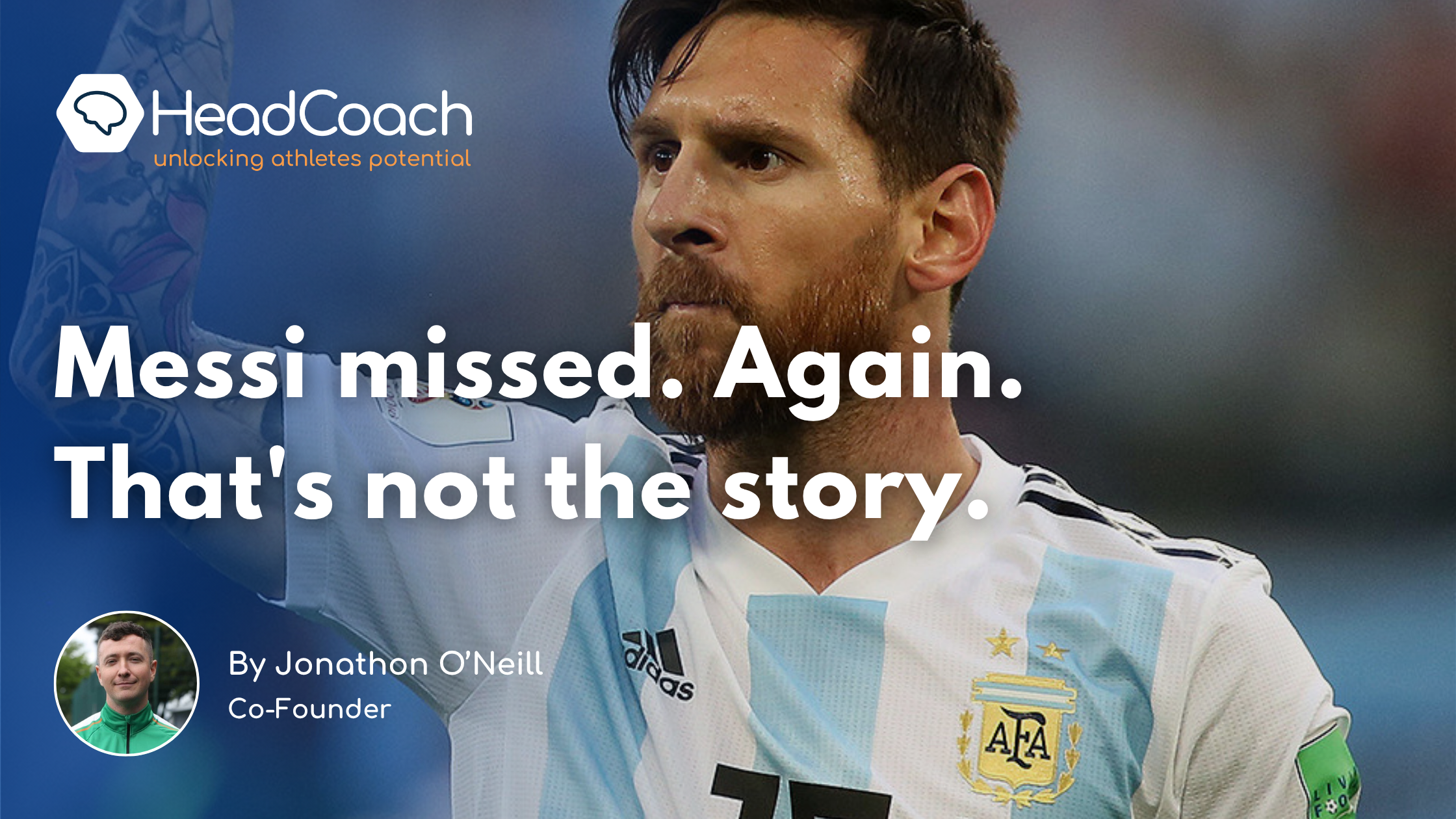
This week in Atlanta, Lionel Messi missed his fourth World Cup penalty. More than any player in the history of the tournament, and his second of this World Cup alone. Egypt were 2-0 up with just over ten minutes left, and one of the great international careers was about to end in the last 16.
Then Argentina scored three times in the final quarter of an hour. Messi's goal, a half-volley seven minutes from time, came from a man who had spent half a match carrying the most public miss of the tournament.
He didn't hide from it afterwards, either: "I felt like in that important moment, I had let the team down."
Watch enough football, and you'll hear the same explanation for nights like that: some players just have it. Mentality monsters. Born different.
Every coach who develops young athletes has seen the other version of this story. A talented kid hits a setback. Dropped from a squad, a mistake that costs a game, a trial that goes badly. They lose belief and quietly drift out of the sport. Not because they were missing a mentality gene. Because nobody ever trained the skill Messi showed between the miss and the final whistle.
That skill has two trainable parts.
The first is how an athlete perceives pressure. Pressure isn't fixed. It passes through a lens, and the lens can be trained toward a more positive frame. A player who steps up thinking "this could go wrong and everyone will see it" is in a threat response: tight, hesitant, narrow vision. Notice where that player's attention has gone. Onto the miss, the crowd, the consequences. Everything except the strike itself. The same player stepping up thinking "this is my chance to show what I've trained," is in a challenge response. They think action, not aftermath. Same moment, same stakes, different body.
The second is what happens in the seconds after a mistake. Untrained athletes replay it, and their next five actions suffer for it. Trained athletes think next action. And that is worth remembering: "next action" is not a slogan you shout on matchday. It's a habit, built on the pitch in training, long before the moment that tests it. Acknowledge the mistake, reset attention on the next action, then review it properly after the game. What happened, what you felt, what changes next time. Not soul-searching. Structure.
Now, the obvious objection. Messi bounces back because he's Messi. The best player in the world knows he's the best player in the world. Fair. But ask where that certainty comes from. It isn't a mood. Competence came first, banked rep by rep over twenty years of training. Confidence followed. That is always the order. Your under-16 doesn't have two decades of proof yet. That's exactly why the skill gets trained, not waited for.
Here's the uncomfortable part for those of us who run programmes: we periodise "strength", speed and "technical" work down to the week, then leave the skill that decided Argentina v Egypt to chance and personality.
If a skill determines game outcomes, it deserves a place in their training week.
Image credit: Photo: Кирилл Венедиктов /soccer.ru, CC BY-SA 3.0